
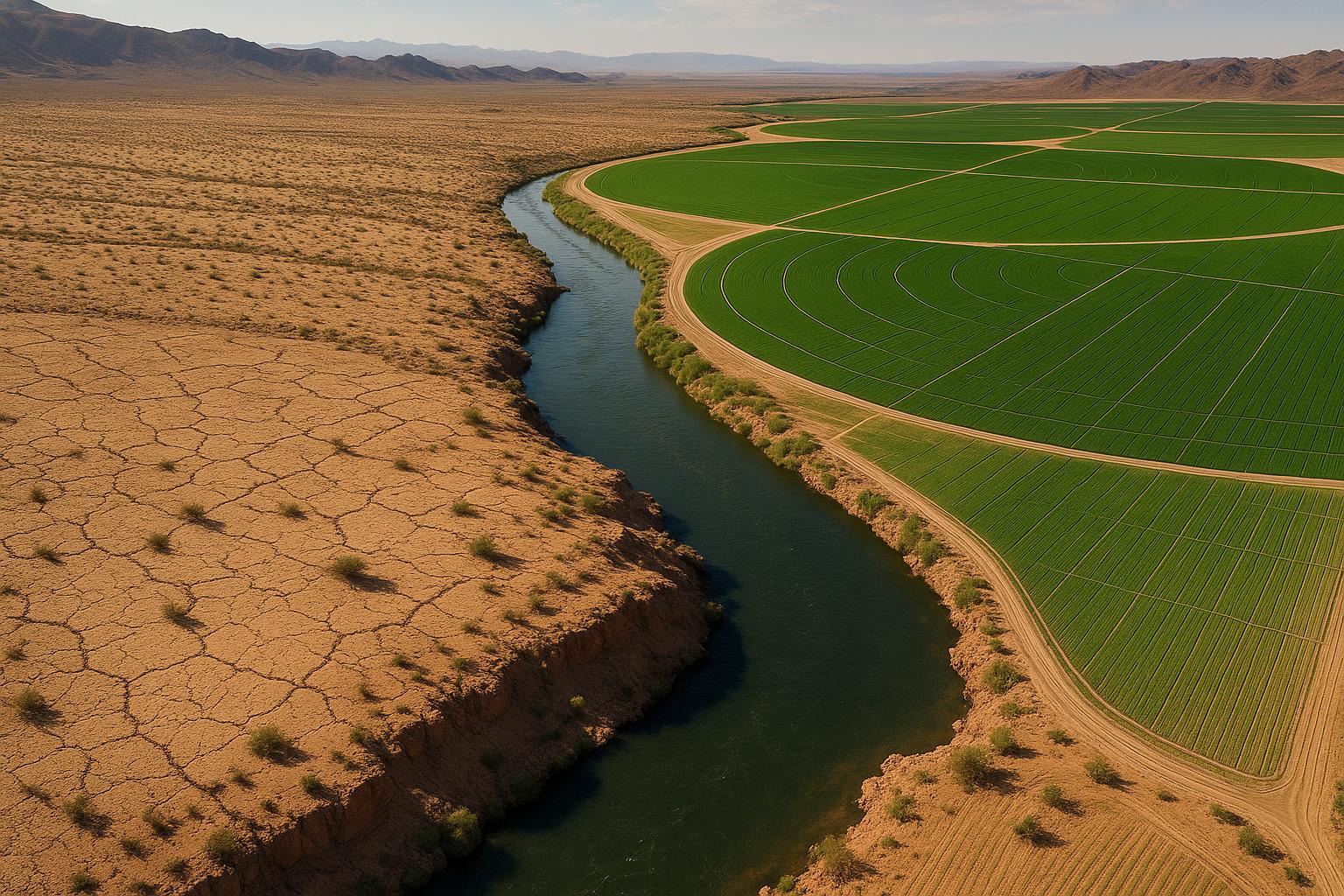
Arizona is considering a $5 billion desalination pipeline from Mexico, but the real lesson from Israel isn't about mega-projects—it's about building resilience through conservation, recycling, and integrated planning that treats desalination as one tool in a diversified portfolio.
In This Article
- Why Arizona's groundwater and Colorado River supplies are both in long-term decline
- The proposed Puerto Peñasco desalination project: scope, cost, and environmental trade-offs
- How Israel transformed water scarcity into a solved problem through integrated national planning
- Conservation, drip irrigation, and wastewater reuse can deliver more water security per dollar than desalination alone
- A policy roadmap for Arizona: mandatory conservation, groundwater regulation, and strategic desalination
Arizona is running out of water, and the state knows it. The Colorado River, which supplies roughly 40 percent of Arizona's water, is in the grip of a megadrought that has persisted for over two decades. Simultaneously, groundwater withdrawals in the Phoenix area and elsewhere are outpacing natural replenishment, creating an implicit deadline for action. Into this crisis steps an ambitious proposal: an Israeli company called IDE proposes to build a desalination plant in Puerto Peñasco, Mexico, pump desalted seawater across 200 miles of desert terrain and over 2,000 feet of elevation gain, and deliver it to Arizona thirsty cities and farms. The price tag exceeds $5 billion. The unit cost of water would be roughly ten times what Arizona currently pays for Colorado River allocations. And the environmental costs—brine discharge into the Gulf of California threatening endangered species, pipeline corridors cutting through protected ecosystems—are substantial and largely unresolved.
The Water Crisis That Cannot Be Ignored
Arizona's water predicament is not a distant threat. The state pumps groundwater faster than nature replenishes it, a practice that has worked for decades only because aquifers stored water from wetter centuries. That buffer is depleting. Studies project a groundwater supply shortfall of approximately 4 percent over the next hundred years in the Phoenix area alone, a figure that prompted state officials to curtail some groundwater-dependent development. The Colorado River situation is more acute. The river now delivers less water than its original compact promised. Climate change, higher temperatures, and persistent drought have reduced flows below historical averages, triggering emergency cuts to downstream users. Arizona, as a junior water rights holder on the river, faces the prospect of further allocation reductions. Agriculture, which consumes over 70 percent of the state's water, remains heavily dependent on flood irrigation methods and largely exempt from statewide water-use restrictions. Mining, another major water user, operates under minimal groundwater regulation in many jurisdictions. This combination of finite supply and inefficient demand creates a genuine crisis that demands more than incremental adjustments.
The Desalination Proposal Under the Microscope
The IDE project represents a technological answer to a fundamentally political and economic problem. The proposed plant would desalinate seawater at Puerto Peñasco on the Mexican coast, then pump the product northward through a pipeline that would cross the Organ Pipe Cactus National Monument and traverse fragile Sonoran Desert ecosystems before reaching Arizona distribution networks. The engineering is feasible. The financing is theoretically possible. But the costs reveal the limits of desalination as a primary solution. At a unit cost ten times higher than Colorado River water, desalination is economically competitive only when other sources are unavailable or when the marginal value of additional water is extremely high. Moreover, the $5 billion estimate typically excludes long-term energy costs, maintenance, and capital replacement over a fifty-year operational horizon. Levelized across the project's lifetime and factoring in the energy required to run continuous desalination and maintain pressure in a massive uphill pipeline, the true cost per unit of water is likely substantially higher. The environmental case is equally troubling. Desalination generates brine—highly concentrated saltwater that is difficult to dispose of responsibly. Discharge into the Gulf of California would increase salinity in a region already stressed by low freshwater inflow. The totoaba, a critically endangered fish, and the vaquita, a porpoise reduced to fewer than twenty individuals in the wild, inhabit this same body of water. Additional salt stress could tip these species toward extinction. The pipeline itself would fragment habitat and require maintenance access roads through protected areas, compounding ecological damage.
Israel's Real Lesson For Water Security
Israel operates in a region as arid as the American Southwest, with per capita water availability one-tenth that of Arizona. Yet Israel has transformed chronic water scarcity into a managed, largely solved problem. The key was not a single mega-project but a comprehensive, integrated national water strategy. Israel established a mandatory national water master plan that coordinates supply and demand across all sectors. Desalination is a major component of Israel's portfolio, but it was not the first or only tool. Israel invested heavily in agricultural efficiency, converting most irrigation from flood methods to drip irrigation, which cut water consumption per unit of crop by 30 to 50 percent. The country built institutional frameworks for recycling treated wastewater, with over 80 percent of Israel's wastewater now reused for irrigation and aquifer recharge. Israel also implemented strict groundwater regulation, preventing mining and agriculture from withdrawing water faster than aquifers recharge. Conservation was made mandatory rather than voluntary; the national water authority has legal authority to enforce water budgets and penalize excessive use. Only after these measures were implemented at scale did Israel add desalination to the portfolio, and even then, desalination is continuously reviewed for cost-effectiveness against alternatives. The result is that Israel achieves water security despite having no renewable surface water comparable to Arizona's Colorado River allocation. This is not a blueprint to copy identically, but it is a model of prioritization that Arizona has largely inverted.
Conservation And Efficiency As First Steps
Arizona consumes water inefficiently, particularly in agriculture. Flood irrigation, which dominates, loses substantial water to evaporation and runoff. Switching Arizona's irrigated agriculture to drip or precision irrigation systems would reduce consumption by 20 to 40 percent depending on crop type and soil conditions. The technical barriers are minimal; the equipment exists and is proven. The barriers are economic and political. Farmers investing in new infrastructure face upfront costs and assume yield and operational risks. Without subsidies, mandatory regulations, or strong financial incentives, adoption has been slow. Yet the cost of installing drip irrigation statewide would be a fraction of the desalination project. Conservative estimates suggest a cost per unit of water saved that is one-fifth to one-tenth the cost of desalinated seawater. Conservation itself—reducing per capita consumption through pricing, behavioral change, and technological efficiency in homes and businesses—offers additional low-cost savings. Arizona's current water pricing does not reflect scarcity. Raising prices to levels that cover true supply costs and incentivize conservation would reduce demand without regulatory mandates. Wastewater recycling, another Israeli success, remains underutilized in Arizona. Treated municipal wastewater is often discharged to rivers rather than reused for irrigation, industrial cooling, or aquifer recharge. Expanding recycling infrastructure would increase effective supply and reduce pressure on groundwater and surface sources.
Groundwater Regulation And Long Term Planning
Arizona's groundwater law is a patchwork of regulations, exemptions, and historical quirks that reflect the state's agricultural past rather than its water-scarce future. Rural areas outside Active Management Areas face minimal or no restrictions on groundwater withdrawal. Mining operations, despite substantial water consumption, operate under exemptions or minimal oversight in many jurisdictions. Urban areas have stricter rules, but the system lacks the unified authority and consistent enforcement that Israel built into its national water framework. Establishing a statewide groundwater regulation system that limits withdrawals to sustainable levels, eliminates exemptions for large users like mining, and bases allocations on hydrological reality rather than historical practice would be politically difficult but necessary. Arizona's state government would need to establish or strengthen a water authority with genuine regulatory power, legal standing to enforce withdrawal limits, and mandate compliance across all sectors including agriculture and mining. This is not a technical problem; it is a governance challenge that requires political will and coordination across fragmented local, state, and federal jurisdictions.
Building A Diversified Water Portfolio For Arizona
The path forward for Arizona is not to reject desalination outright but to reorder priorities. Desalination should be considered as one component of a diversified portfolio only after conservation, efficiency, recycling, and regulation have been implemented at meaningful scales. This reordering would increase overall resilience because it spreads risk and cost across multiple sources rather than betting the state's future on a single expensive technology dependent on sustained energy supply and Mexican cooperation on cross-border issues. A realistic portfolio for Arizona might look like this: first, implement mandatory statewide conservation standards and efficiency requirements in agriculture, mining, and urban use, reducing demand by 15 to 20 percent within ten years. Second, expand wastewater recycling to capture and reuse 50 to 60 percent of treated municipal water. Third, regulate groundwater extraction to sustainable levels, with no exemptions for large users. Fourth, provide financial incentives for agricultural conversion to drip irrigation, targeting a 30 percent improvement in irrigation efficiency statewide. These four measures, combined, could add effective supply equivalent to 30 to 40 percent of current Colorado River allocations. The cost would be measured in hundreds of millions, not billions. Only after these measures are demonstrably implemented and their potential exhausted should desalination be reconsidered as a marginal supply source. If a desalination project is pursued at that point, it should be scaled to fit within a portfolio rather than serve as the primary solution, and it should be built with full cost accounting, rigorous environmental review, and genuine consent from affected communities in both Arizona and Mexico.
Governance And Cross Border Politics
Arizona's water future cannot be solved by Arizona alone. The Colorado River Compact binds Arizona to multi-state agreements and limits unilateral action. The desalination proposal requires Mexican cooperation, including permits, cross-border agreements, and coordination on Gulf of California management. Tribal nations in Arizona and Mexico hold water rights and occupy lands affected by both the current crisis and any proposed solution. Building the governance structures necessary for integrated water management requires negotiation at multiple levels and genuine incorporation of affected stakeholders' voices. This is slower and messier than a single mega-project, but it is more sustainable. Israel's national water strategy succeeded partly because Israel has a centralized government capable of coordinating across sectors and imposing uniform standards. Arizona operates in a federal system with multiple sovereigns and fragmented authority. Nonetheless, the principle of integrated planning can be adapted. A statewide water policy framework that sets binding conservation standards, allocates groundwater based on hydrological limits, and creates transparent mechanisms for prioritizing competing demands would constitute a major advance. Such a framework would also provide a rational basis for evaluating whether and at what scale desalination should be pursued.
jordan_bio
Recommended Books
The Water Conflict Nexus by Nils Petter Gleditsch — explores transboundary water management and the geopolitical dimensions of water scarcity and cooperation across international borders.
Cadillac Desert: The American West and Its Disappearing Water by Marc Reisner — a definitive history of water politics and engineering in the American West that contextualizes Arizona's current predicament within decades of policy choices.
The Global Water Crisis: Addressing an Urgent Security Issue by Raphael J. Kazmann — examines water scarcity as a security challenge globally and analyzes policy approaches to sustainable water management.
Article Recap
Arizona faces a genuine water crisis driven by groundwater depletion and Colorado River drought, and while a $5 billion desalination pipeline from Mexico is technically feasible, the costs are prohibitive and environmental risks substantial when compared to integrated water management approaches. Israel's successful model prioritizes conservation, drip irrigation efficiency, wastewater recycling, and groundwater regulation before turning to desalination, a sequence Arizona has largely inverted. By implementing mandatory conservation standards, expanding agricultural irrigation efficiency, regulating groundwater sustainably, and recycling treated municipal water, Arizona could add effective water supply equivalent to 30 to 40 percent of current Colorado River allocations at a fraction of desalination costs, treating desalination as a marginal portfolio component only after other measures are exhausted.
#Arizona #WaterCrisis #Desalination #IsraelWaterStrategy #WaterConservation #ColoradoRiver #DripIrrigation #WastewaterRecycling #GroundwaterManagement #WaterPolicy