
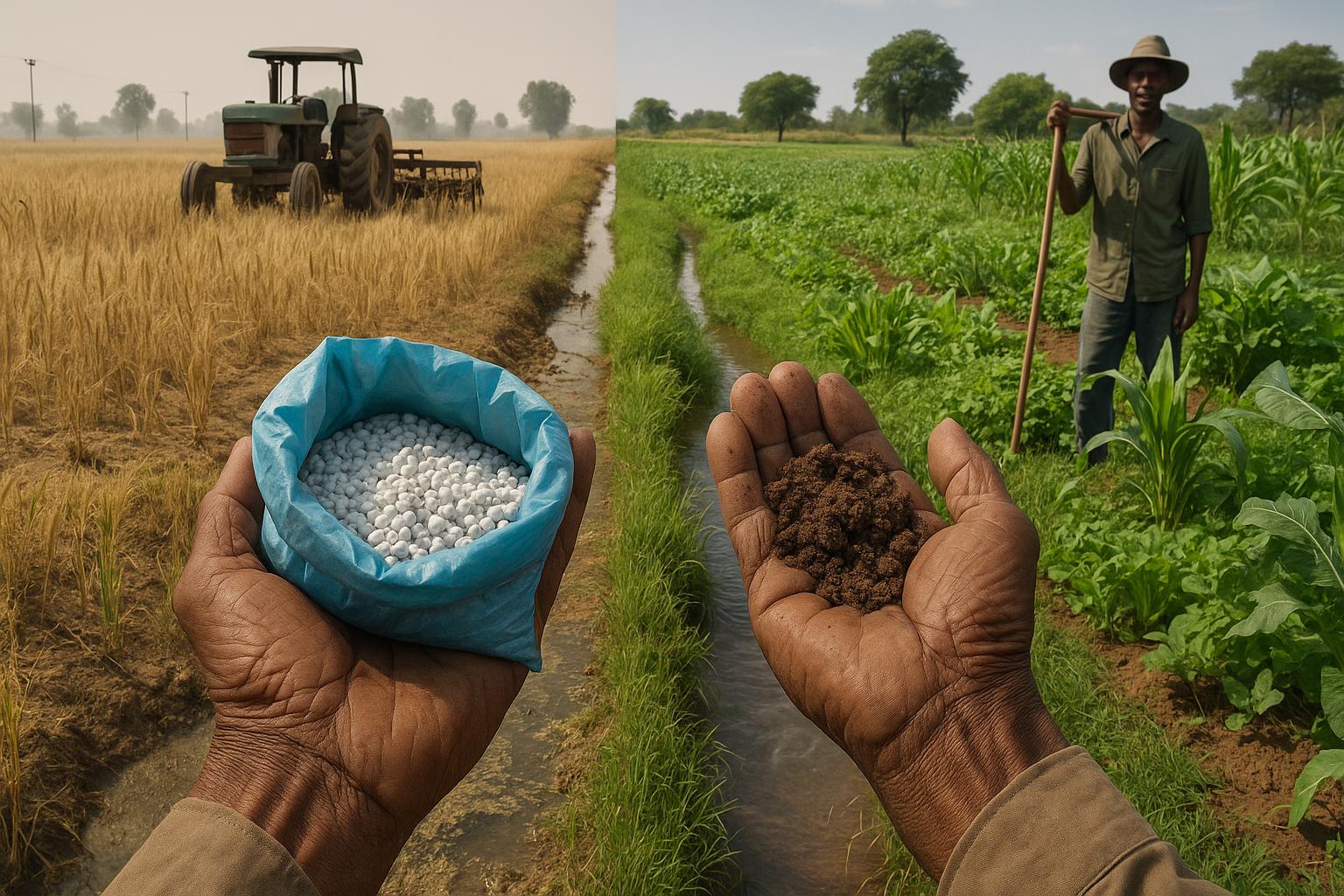
The Green Revolution's triumph in India is largely myth. Policy choices and fertilizer subsidies, not miracle seeds, drove wheat booms while creating decades of import dependence, environmental devastation, and economic burden. As Ethiopia mimics this failing model, the question isn't whether we can repeat the past, but whether we have the courage to abandon it.
In This Article
- How policy choices, not superior seeds, created India's wheat boom after independence
- The dramatic rise in fertilizer intensity and the hidden costs of synthetic input dependence
- Environmental and health impacts from agrochemical runoff in Punjab and beyond
- Why Ethiopia's fertilizer-heavy wheat strategy replicates a failing model
- Climate-resilient, low-input alternatives that offer genuine food security
When Norman Borlaug received the Nobel Peace Prize in 1970 for his work on high-yield wheat varieties, the world celebrated a triumph of science over hunger. The narrative was clean: new seeds saved millions. In India, M.S. Swaminathan became the face of a nation achieving food self-sufficiency through agricultural innovation. Yet this story obscures a more complicated truth. India's wheat boom was engineered not by seeds alone but by deliberate policy choices that locked the country into a cycle of fertilizer dependence, environmental damage, and perpetual import bills that persist today.
The Myth of the Miracle Seed
The conventional account credits the Green Revolution with rescuing India from famine. This narrative overlooks a crucial historical fact: India's food crisis in the 1960s was not primarily a problem of agricultural capacity but of policy. Post-independence governments prioritized certain crops through price supports and procurement policies. When wheat prices rose, farmers responded by shifting land use. The seeds mattered less than the incentives. High-yielding varieties required more water, more chemicals, and more labor, but they succeeded because state policy made them profitable, not because they were inherently superior to alternatives.
Fertilizer Intensity and Economic Dependence
The cost of this policy choice became apparent within a decade. In 1965, India applied roughly 8 kilograms of fertilizer per ton of food produced. By 1980, this figure had surged to 44 kilograms per ton. This sevenfold increase reflected not a triumph of efficiency but a deepening dependence on imported synthetic inputs. India's fertilizer import bill reached $17.3 billion in 2022, cementing the nation as the world's second-highest fertilizer importer. The economic logic was cruel: governments subsidized fertilizer to make Green Revolution crops competitive, which in turn required ever-larger subsidies as soil fertility declined and input prices climbed.
This dependency created a structural vulnerability. When Russia and Ukraine entered conflict, global fertilizer supplies tightened and prices surged. Nations dependent on imported fertilizer faced immediate crises. India, despite decades of pursuing self-sufficiency through intensive agriculture, remained exposed to geopolitical shocks and volatile commodity markets. The irony is stark: the strategy meant to secure food independence created a new form of dependence.
Environmental Costs and Public Health Consequences
The environmental toll mounted silently for years before becoming undeniable. Globally, only about 17 percent of applied synthetic fertilizer is actually taken up by plants. The remainder leaches into groundwater, runs off into rivers, and accumulates in soil. In Punjab, the heartland of India's Green Revolution, this has meant contaminated drinking water, dead zones in rivers, and rising rates of kidney disease and cancer linked to nitrate contamination. Intensive pesticide use compounded the damage, poisoning waterways and creating resistant pest populations that required ever-larger chemical applications.
These costs were externalized, never included in the cost-benefit analyses that celebrated the Green Revolution. Farmers bore the health consequences. Rural communities drank poisoned water. Ecosystems collapsed. Meanwhile, the narrative of success remained unquestioned in policy circles.
Ethiopia's Fertilizer Gamble
Today, a new nation is making the same bet. Ethiopia has invested approximately $1 billion in fertilizer procurement in recent years, betting that input-intensive wheat cultivation will generate export revenue and food security. The government projects wheat exports worth over $100 million annually. This mirrors India's strategy exactly: state subsidies, high-input cultivation, and the assumption that yield growth solves food insecurity. The model carries the same hidden costs. Ethiopia's climate is hotter and drier than Punjab's, making it more vulnerable to soil degradation and water stress. The same fertilizers that poisoned Punjab's groundwater are now being applied to Ethiopian soil.
The cautionary tale is clear. Ethiopia may achieve short-term wheat production gains. But it will also lock itself into fertilizer imports, create environmental liabilities that will take decades to reverse, and leave itself exposed to the same commodity-price shocks that periodically destabilize global agriculture. The promised export revenues may never materialize at the volumes projected, while the true costs will be borne by rural health and long-term agricultural viability.
The Path Forward: Beyond Input Intensity
Climate change makes the Green Revolution model obsolete. The strategy assumes stable water availability, predictable rainfall patterns, and reliable access to imported inputs. None of these assumptions hold in a warming world. Droughts intensify. Supply chains fracture. Farmer debt spirals when input costs rise faster than commodity prices. The alternative is not nostalgia for pre-modern agriculture but a deliberate shift toward systems that are genuinely resilient.
Low-input farming systems based on crop diversity, soil health, and water conservation produce stable yields with far lower vulnerability to shocks. Agroforestry integrates trees with crops, improving water retention and soil fertility while generating diversified income. Participatory seed selection and breeding programs develop varieties suited to local conditions rather than imposing uniform seeds across varied landscapes. Push-pull farming reduces pest damage while enhancing soil fertility. These approaches do not eliminate the need for knowledge and investment, but they redirect both toward building ecological capacity rather than purchasing external inputs.
Policy Instruments for Transition
Shifting away from input dependency requires deliberate policy change. Price supports that favor chemical-intensive monocultures must be redirected toward diversified, regenerative systems. Agricultural extension services need retraining to promote soil health, water conservation, and integrated pest management rather than fertilizer and pesticide sales. Farmer cooperatives can bulk-purchase improved seeds and equipment at prices lower than individual purchases, reducing the capital barriers to transition. Investment in research and development must prioritize crops and varieties suited to local climates and degraded soils, not high-input varieties bred for optimal conditions that no longer exist.
India and Ethiopia have the opportunity to learn from their own histories and from global experience. The Green Revolution succeeded in achieving rapid production increases. It failed by creating dependencies that persist, environmental damage that will require decades to reverse, and vulnerability to the exact geopolitical and climatic shocks that are now defining global agriculture. A second revolution is not needed. What is needed is the political will to pursue pathways toward genuine food security that strengthen rather than deplete the natural systems on which agriculture depends.
jordan_bio
Recommended Books
The Greening of America's Food Supply: From Hype to Hope by Glenn Davis Stone — A critical examination of how the Green Revolution shaped agricultural policy in India and why high-input systems created unsustainable dependencies.
Dirt: The Erosion of Civilizations by David R. Montgomery — An exploration of soil degradation across civilizations and the long-term agricultural consequences of intensive input-based farming practices.
The Land We Share: Land Grant Universities and the Public Good by Paul B. Thompson — An analysis of how agricultural research institutions have shaped farming practices and the possibilities for redirecting agricultural science toward sustainability.
Article Recap
The Green Revolution in India was not the triumph of superior seeds but the result of deliberate policy choices that prioritized yield growth over long-term sustainability. State subsidies pushed fertilizer use from 8 kilograms per ton in 1965 to 44 kilograms per ton by 1980, creating permanent import dependence and environmental devastation in Punjab. As Ethiopia now pursues a similar fertilizer-intensive wheat strategy, it risks repeating these failures in a climate far less forgiving than Punjab's. The path forward requires transitioning to low-input, climate-resilient agriculture that strengthens rather than depletes natural systems, backed by policy instruments that support farmer transition and agricultural research aligned with genuine food security.
#GreenRevolution #FertilizerDependency #FoodSecurity #AgriculturePolicy #India #Ethiopia #SoilHealth #ClimateResilientFarming #AgroEcology #SustainableAgriculture